How Vacation Rental Property Managers Maximize Amazon Business
Even operators with solid purchasing procedures run into friction with Amazon that compounds quietly over time. This guide covers it all, setting you up to save money, time, and headaches, so you can better leverage the benefits of Amazon Business.
Section 1: Amazon Business Pricing: Why Most Vacation Rental Operators Overpay
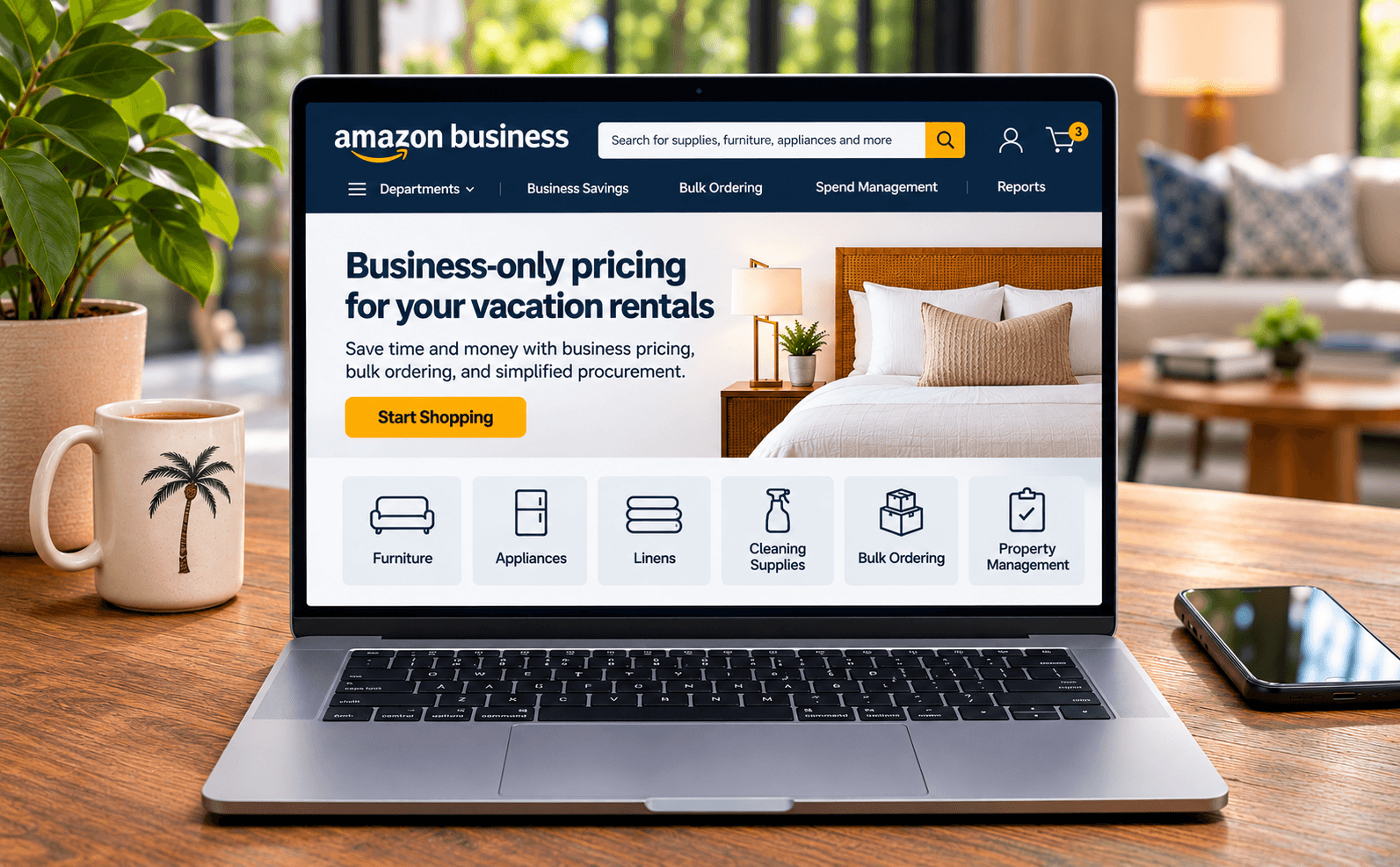
Pricing is the most immediate lever operators can pull on Amazon, and also the one most commonly left unoptimized. The assumption that Amazon is already cheap enough at scale is wrong. What you pay is heavily influenced by your account setup, your purchasing habits, and whether you are buying alone or as part of a larger group.
Amazon Business Prime vs. Regular: What You Actually Get
Most operators know Amazon Business exists. Fewer have taken the time to understand which tier actually matches their operation. There are five levels of Amazon Business Prime, each unlocking meaningfully different features:
- Amazon Business Duo is the free single-user plan. It separates personal and business purchases and includes basic analytics. A starting point, but not built for teams or scale.
- Amazon Business Essentials adds Spend Visibility dashboards and Guided Buying for small teams. Good for operations just starting to bring multiple buyers onto one account.
- Amazon Business Small expands the user count and adds extended invoice payment terms and enhanced spend analytics. Better suited for operations with a dedicated purchasing or finance function.
- Amazon Business Medium scales further with more robust analytics and longer invoice terms for larger teams managing significant monthly spend.
- Amazon Business Enterprise is the top tier: unlimited users, the longest invoice terms, and full Guided Buying controls including the ability to prefer, restrict, or block specific products and sellers across the entire account.
For operators managing 30 to 3,000+ units with multiple team members placing orders, the free Duo plan is leaving significant features and savings on the table. The right move is auditing your current setup against your unit count, team size, and monthly spend, and upgrading to the tier that actually fits how your operation runs.
The Third-Party Seller Problem
Amazon is a marketplace, not a single retailer. The same cleaning supply, linen, or paper good can be listed by dozens of different sellers at meaningfully different price points, with different fulfillment reliability and different return policies. Even within the same seller, pricing can change day-to-day and is not locked in. There is no built-in prompt alerting you when a better option exists for a product you buy regularly. The default is usually just reordering from whoever sold it last time.
At high unit counts this variability compounds. Consistently buying from a higher-priced seller on consumables you order every month adds up to real money over the course of a year. The solution is standardizing purchasing around vetted product lists built specifically for vacation rental operations, removing the guesswork of identifying which products and sellers are worth buying from and which are not.
Amazon Business Prime unlocks real savings over a standard account, but there is a way to go further without changing how you already buy. HostGPO members get better-than-Amazon-Business-Pro pricing on thousands of pre-selected products, plus 50% off the Amazon Business Prime membership subscription itself for two years.
That combination stacks meaningfully: the membership discount cuts your costs immediately, and the product-level pricing advantages compound across every order placed. For operators spending thousands monthly on Amazon, the math adds up fast, and it's worth factoring in before your next Amazon Business renewal.
It goes further when a category has a brand partner behind it. Where possible, like with Schlage and Diversified Hospitality, HostGPO partners directly with top-selling Amazon brands who offer additional discounts and access to products you cannot get on Amazon at all. With Schlage, that means locks ordered keyed alike or in commercial and marine-grade ratings, options the standard Amazon listing does not carry.
Section 2: Shipping on Amazon Business: The Hidden Operational Risk
Most operators think about Amazon shipping in terms of speed: will this arrive in two days or five. At scale the real question is more complicated. Which orders will arrive when expected, which will split into multiple shipments, and what happens to operations when something does not show up on time. Shipping is where Amazon's marketplace structure creates the most day-to-day operational risk for large vacation rental operators.
Understanding Amazon's Fulfillment Reality
Amazon is not one warehouse. When you place an order, items pull from whatever fulfillment center has them in stock, which might be in California, Nevada, and Ohio simultaneously. Third-party sellers add another layer: they fulfill from their own warehouses on their own timelines, with their own carriers and their own standards for what constitutes on-time delivery.
The result is that one order can generate three, four, or five separate shipments with different tracking numbers, different carriers, and different expected arrival dates. None of that is visible when you click place order. It only becomes apparent when charges start hitting your card at different times and boxes start arriving on different days.
Amazon works best for vacation rental operations as a gap-filler and last-minute resource rather than a primary procurement channel, precisely because this delivery variability is structural and consistent. For planned, high-volume purchasing of predictable consumables, primary suppliers with more reliable lead times are the better default. Amazon fills in the gaps.
The Operational Impact of Unpredictable Delivery
For a single property owner, a delayed Amazon shipment is an inconvenience. For an operator managing 70 to 3,000+ units with tight turnover windows between guest checkouts, it is an operational liability.
Cleaning crews show up and supplies are not there. A guest checks in to find the property understocked because an order that was supposed to arrive Tuesday is still sitting in a fulfillment center in another state. A last-minute run to a local retailer at retail prices eats into margins and burns staff time. At scale these are not edge cases. They are recurring costs that add up quietly month over month.
Building a Smarter Shipping Strategy
The operators who manage Amazon shipping well are not relying on hope. They have built a deliberate strategy around its limitations.
Vetting sellers by fulfillment reliability before committing to a product listing is the starting point. Check whether the item is fulfilled by Amazon directly or by a third-party seller. Amazon-fulfilled items ship from Amazon's own warehouses and tend to be significantly more reliable. Third-party fulfilled items vary widely and are worth scrutinizing before making them a regular purchase.
Identifying which product categories are reliable enough for planned purchasing on Amazon and which are better sourced through a primary supplier reduces exposure to the variability that creates operational problems. Paper goods, certain cleaning products, and standard maintenance supplies often ship reliably. Custom or specialty items are higher risk.
Building buffer stock on high-turnover consumables is the simplest and most effective hedge. When a delayed shipment creates inconvenience rather than a crisis, the operational impact stays manageable. Operators who run lean on inventory absorb the most pain when Amazon's fulfillment does not go as planned.
Some operators have also found practical ways to reduce delivery friction at the property level. Setting up secure parcel drop boxes eliminates doorstep theft and missed deliveries at properties that are not always staffed. Adding detailed delivery instructions to each property address in Amazon, including gate codes, driveway access notes, and preferred drop-off locations, reduces the carrier confusion that leads to failed deliveries. For properties in areas where USPS consistently struggles with access, contacting Amazon support to deprioritize USPS in favor of Amazon's own drivers or FedEx and UPS can make a meaningful difference in reliability.
One area worth having a clear policy on is guest packages. Guests occasionally ship personal Amazon orders to rental properties, which creates liability and theft exposure for the operator. Most operators handle this one of three ways: directing guests to use Amazon Lockers or pickup points nearby, asking guests to ship to the management company's local office instead, or discouraging it entirely in the house rules.
When Last-Minute Delivery Becomes a Guest Experience Tool
Beyond procurement, fast delivery can become an active part of how operators manage their properties and serve guests. When a guest needs extra pillows, batteries, or a fan and the nearest team member is an hour away, same-day delivery is not just convenient, it is operationally valuable. A quick response to a guest need that would otherwise require a store run can be the difference between a four-star and a five-star review.
The same logic applies to supply restocking during peak seasons. Rather than coordinating manual restocking runs between checkouts, operators can have supplies delivered directly to the property and received by housekeeping on site. No central warehouse required, no wasted team time driving back and forth.
Fast delivery also creates guest experience opportunities that go beyond solving problems. Stocking a fridge before arrival or sending a small gesture when something goes wrong are the kinds of touches that generate the reviews and repeat bookings that drive long-term revenue. For operators looking to build this into their operation, same-day delivery platforms like Instacart Business make it straightforward, and HostGPO is worth checking out for operators who want to explore what delivery partnerships are available through their network.
A smarter shipping strategy reduces operational surprises and keeps properties running smoothly between checkouts. It also has a less obvious benefit: fewer split shipments and more reliable fulfillment makes the tracking and reconciliation work downstream significantly more manageable. Which brings us to the part of Amazon that quietly consumes the most staff time at scale.
Section 3: Tracking Amazon Orders Across a Large Portfolio
Tracking Amazon orders seems straightforward until it is not. Even a single buyer managing one account runs into the core problem: Amazon is not built to tell you what was bought for which property. At 70+ units that gap does not just create inconvenience, it creates a genuine operational and financial problem that compounds with every order placed. The challenge is not that Amazon lacks tools. It is that the tools it does have were built for general business purchasing, not for the property-level visibility that vacation rental operations depend on.
Where Amazon's Native Tools Fall Short
Amazon Business offers multi-user accounts, purchase approvals, spending limits, and order history exports. These are genuinely useful features, but they are designed for general business purchasing, not for the specific demands of vacation rental operations.
The most significant gap is property-level visibility. There is no native way to tag an order to a specific property at the time of purchase. Without that, order history across multiple buyers and multiple cards becomes an unnavigable wall of transactions. You can see what was bought and when. You cannot easily see what was bought for which property, by whom, and why, without doing significant manual investigation after the fact.
The Property Allocation Problem
Knowing what was bought for which unit is the foundation of accurate owner billing and property-level financial reporting. It is not optional at scale. It is the difference between financial reports that reflect reality and ones that require a month of cleanup before they are usable.
Without a tagging system at point of purchase, property allocation has to be reverse-engineered. That means digging through shipping addresses, order notes, and team communications trying to reconstruct context that should have been captured when the order was placed. At 70+ units with multiple buyers placing orders throughout the month, this process consumes significant staff time and introduces errors that flow through to owner statements and reporting.
How to Solve the Tracking Problem
The operators who have solved this are using software that connects directly to their Amazon Business account and does the matching automatically. Rather than reverse-engineering property allocation after the fact, the tool reads order data, cross-references it against a property list imported from the PMS, and assigns purchases to the correct unit based on shipping address, purchase order fields, and naming conventions. The finance team reviews and approves rather than building the allocation from scratch.
Instead of a monthly exercise in reconstruction, property-level expense tracking becomes a review process. Orders flow in, get assigned, and are ready for owner billing without anyone having to chase down context after the fact. For vacation rental operators looking for that platform, Topkey does exactly this, and more than 300 property management companies managing over 40,000 properties are already using it to close their books faster every month.
Section 4: Reconciling Amazon Business Charges at Scale
Of the four areas this guide covers, reconciliation is where most operations feel the pain most acutely. It is also the area where the problem is least intuitive. Operators often assume reconciliation is hard because their process is not good enough. In reality the difficulty is baked into how Amazon's billing works, and understanding that distinction changes how you approach the solution.
Why Amazon Reconciliation Is Structurally Difficult
Amazon does not charge your card when you place an order. It charges when items ship. For a small order shipping in one box, this is a minor detail. For a large operation placing dozens of orders monthly across multiple properties, it creates a serious accounting problem.
A single order placed on Monday can generate charges on Wednesday, Friday, and the following Tuesday depending on where items are shipping from and when they leave the warehouse. By month end, a finance team at a 100-unit operation might be looking at hundreds of card charges that need to be matched back to original orders, none of which have obvious connections to each other on a bank statement.
This is not a process failure. It is a structural limitation of how Amazon's fulfillment and billing works. It affects well-run operations just as much as disorganized ones.
The Split Shipment Problem
Split shipments are the specific mechanism that makes reconciliation so difficult. When one order pulls items from multiple fulfillment centers, Amazon creates separate shipments and charges your card separately for each one. A single $500 order might become three card charges arriving over the course of a week.
Each of those charges needs its own receipt for proper accounting. Each receipt needs to link back to the original order. And each needs to be coded to the correct property. When this happens across dozens of orders in a single month, the manual work of connecting charges to orders to properties becomes enormous regardless of how disciplined the team is.
What Your Bookkeeper Actually Needs
Most bookkeepers working with vacation rental operators at scale will tell you the same thing: Amazon is the hardest account to reconcile every month. Descriptions that mean nothing to an accounting system. Charges that appear days after the order was placed. Receipts that do not match what landed on the card statement. And no clean trail connecting any of it back to a specific property.
The downstream consequences are real. Owner billing gets delayed. Month-end close slows down. And audit exposure grows with every charge that sits unresolved while someone tries to track down an order confirmation from three weeks ago.
Building a Reconciliation System That Scales
The honest answer is that no manual process solves this at scale. The volume is too high and the structural quirks of how Amazon bills are too consistent to outwork with spreadsheets and discipline alone.
What actually moves the needle is having a platform that sits between Amazon and your accounting system, ingests data from both sides, and does the matching, receipt generation, and description cleanup automatically. When that is in place reconciliation stops being a monthly project and starts being a quick review. Closes happen faster, owner statements get cleaner, and the finance team gets their time back. Topkey is that platform, getting reconciliation off your team's plate so they can focus on the business instead of chasing receipts.
Conclusion
Most vacation rental operators are getting some value out of Amazon Business. The ones running it well are getting significantly more, and the difference usually comes down to four things: pricing, shipping, tracking, and reconciliation.
Pricing gets better with the right account tier. HostGPO members get better-than-Amazon-Business-Pro pricing on thousands of products and 50% off their Amazon Business Prime subscription. Shipping gets more predictable with a smarter procurement strategy that treats Amazon as a complement rather than a primary supplier. Tracking and reconciliation get manageable with tools like Topkey that do the work Amazon cannot do natively.
The operators running Amazon well are not doing anything extraordinary. They have just stopped absorbing the friction silently and started addressing it systematically. That shift pays off every single month.