Airbnb direct booking links: cutting the host fee down to 6%
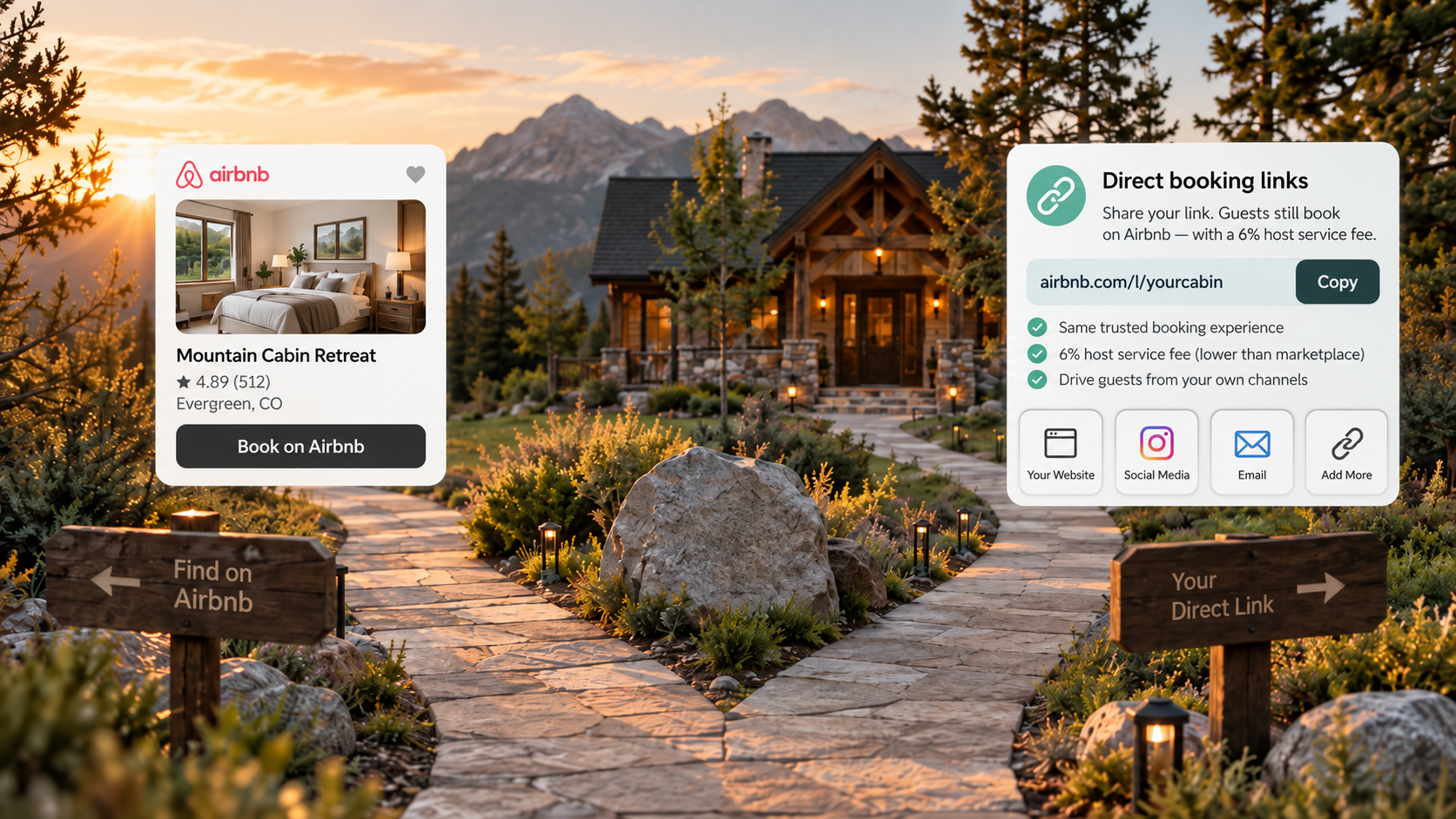
Airbnb is quietly testing a "direct booking link" that drops the standard host fee to 6% or 10% when you bring your own guest.
The feature, which was first reported at the end of August, has been circulating in operator Facebook groups and on LinkedIn ever since. While the pilot is limited, the mechanics are half-documented, and the name is a bit of a stretch of the term 'direct booking,' there is no denying the excitement it has brought to inner industry circles. Whether or not it is justified will remain to be seen.
How does it work?
If you’re part of the select group of hosts picked to test this feature, you’ll get a toggle inside the listing editor that generates a custom tracked URL. Share that link wherever you already reach travelers (like on your Instagram, your past-guest email list, a QR code in the unit, etc). If a guest books through that link, your service fee falls from 15.5% to either 6% or 10%.
Everything else stays put. The checkout runs on Airbnb, the payment runs through Airbnb, AirCover still applies, and the guest's contact data stays Airbnb's. Airbnb just skips the expensive part of its job, which is finding the traveler, and prices accordingly.
The math is the story
To see the savings in action, let's run it on a $1,000 stay. At 15.5%, Airbnb takes $155 and you keep $845. At the 10% tier, Airbnb takes $100 and you keep $900. At the 6% tier, Airbnb takes $60 and you keep $940. That's $55 to $95 more in your pocket per $1,000 booked, on stays you sourced yourself.
You can pass some of the savings to the guest as a lower price, capped at the size of your fee cut. A host on the 6% tier can hand up to 9.5% back to the guest. You keep the savings or you give them away to sharpen your pricing, but you can't do both.
"Direct" is the wrong word
The truth of the matter is that this is not a 'direct booking,' so we might as well just call it what it is: an affiliate deal. You share a tracked link, Airbnb pays you a referral commission, and the commission shows up as a lower fee instead of a check. That's a clean affiliate arrangement, and it's a genuinely good one. But to call it a pure ‘direct booking’ wouldn’t be accurate.
Direct booking means the guest books on a channel you control, you own the relationship and the contact details, and no platform takes a commission. Airbnb's link sends the guest right back into Airbnb's system. The guest stays Airbnb's guest, the data stays Airbnb's data, and the rate stays Airbnb's to change. The rollout emails call it a pilot and warn that Airbnb may adjust it or pull hosts in and out of the program. So while hosts might get a better fee today, they do not own the terms in the same way they would with a genuine direct booking.
Why Airbnb is doing this now
Over the past year Airbnb moved nearly everyone onto a single host-paid fee, and that structure lets Airbnb adjust commissions entirely behind the scenes, in host dashboards, without touching the price guests see at checkout.
Meanwhile, Google is testing agentic hotel booking inside its AI Mode with Booking Holdings, Expedia, Marriott, and IHG. Airbnb is pointedly not on that partner list. On the Q2 2026 call, Brian Chesky rejected feeding Airbnb inventory into someone else's AI assistant, betting instead on Airbnb's own brand and app. But betting on your own brand is expensive: Q2 sales and marketing spend hit $875 million, up 27%, outpacing 17% revenue growth.
Against that backdrop, traffic driven by your Instagram or your email list is close to free for Airbnb. It skips Google, skips the AI intermediaries, and costs Airbnb nothing upfront. Shifting guest acquisition off the corporate marketing budget and onto a flexible commission rate is a cheap way to buy traffic. The 6% versus 10% split is almost certainly an elasticity test, Airbnb measuring how much host-sourced traffic it gets per basis point it gives up.
What this means for your properties
The pilot rewards the exact assets a real direct channel runs on: a past-guest email list, a social following, and QR codes in the unit. Airbnb is paying you to point those assets at Airbnb, but those same assets point anywhere you tell them to. If you've got an audience big enough to earn the lower fee, you've got an audience big enough to book on a channel you actually own, where the fee is zero and the guest is yours.
If we were to summarize everything in the news around this, we’d suggest you treat the link as a tactic, not a strategy. If you're invited and the attribution shakes out, running repeat guests through it beats paying full freight. Who amongst us wouldn’t want to retain more of our revenue?
Just don't let a lower Airbnb fee talk you out of building the type of foundation that eventually allows you to keep the whole thing.